
Fingerprints of Life and Rosetta Stones: Exploring Extreme Environments on Earth to Search for Life on Mars - Livestream
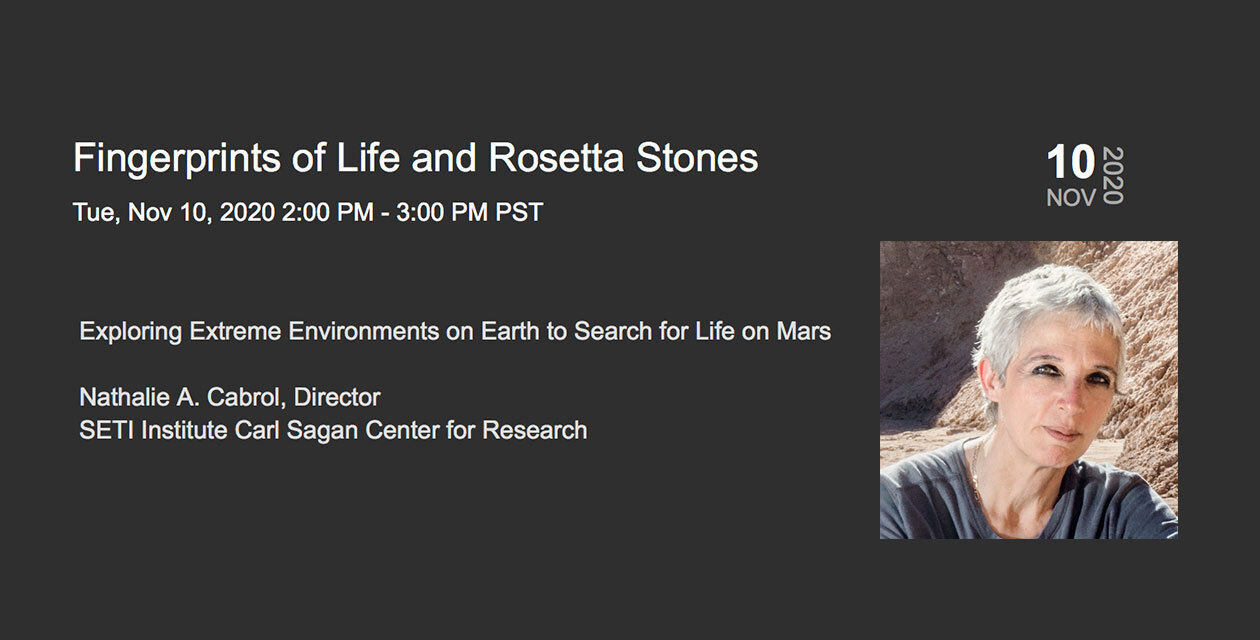
The Mars Exploration Rover and Mars Science Lab missions have demonstrated that early Mars was habitable for (primitive) life as we know it. However, missions now on their way to Mars are shifting their objectives from the characterization of habitable environments to the search for prebiotic chemistry and biosignatures on Mars, an exploration that requires a different approach to understand what to search for, where to search, and how to search. The study of terrestrial extreme environments plays a critical role in the preparation for these missions, and the support of their operations. Study sites in the Atacama Desert, the altiplano, and the Andes represent the closest analogs on Earth to early Martian environments. Through the study of the distribution, abundance, and nature of microorganisms that survive there, and the types and composition of environments they have adapted to, we learn what exploration strategies, technology, instruments, spatial scales, and spectral resolution are needed to detect them on Mars. Ultimately -because of the similarities between early Earth and Mars and due to the exchange of planetary material between the two planets in the early times of the Solar System, while terrestrial extreme environments are helping us prepare the search for life on Mars - finding life on Mars could one day help us understand the origins of life on Earth.
Speaker: Nathalie Cabrol, SETI
Tuesday, 11/10/20
Contact:
Website: Click to VisitCost:
FreeSave this Event:
iCalendarGoogle Calendar
Yahoo! Calendar
Windows Live Calendar
SETI Institute


, CA