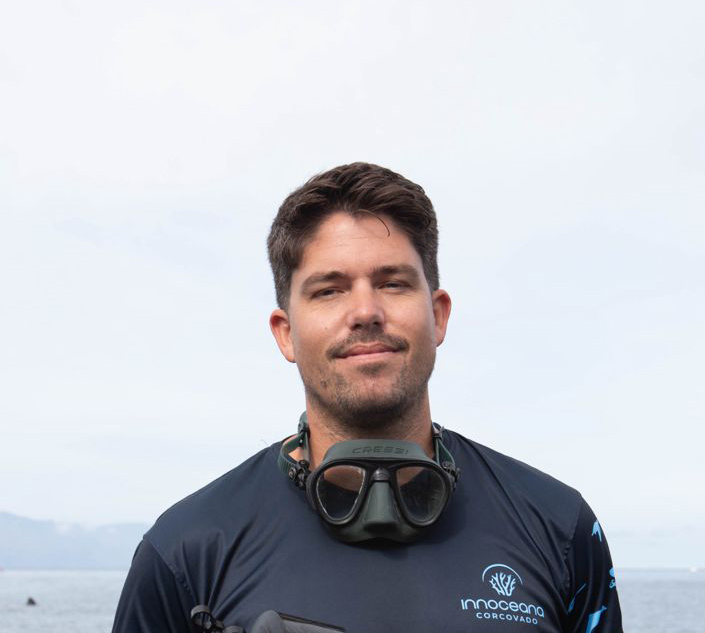
Rising from the deep Atlantic off the coast of the Sahara, the Canary Islands are an extraordinary yet still underexplored marine laboratory. Their volcanic origins, steep submarine slopes, deep waters close to shore, and remarkable diversity of climates and microclimates have created exceptional conditions for marine life. The archipelago supports ...
Plants sense extracellular cues through several hundred cell surface receptors. The most rapidly evolving group of receptors is the leucine-rich repeat receptor-like proteins (RLPs), which transduce immune signals as a bipartite receptor complex with the adapter SOBIR1. In recent years many new examples of immunogenic patterns detected by specific RLPs ...
The dual quests - to understand intelligence as it arises in biology and to build it in machines of our own making - have been with us for nearly a century. While neuroscience and psychology seek to characterize intelligence in terms of underlying neural mechanisms and emergent behavior, we still ...
Mars’s early magnetic dynamo may have had a significant influence on the planet’s climatic evolution and habitability, with its termination potentially triggering the shift to Mars’s present cold and dry conditions. Generation of the dynamo in Mars’s core also connects the magnetic field’s strength and longevity to otherwise-obscured properties of ...
Salt lakes are some of the world’s most extraordinary ecosystems, but nearly all of them - from the Great Salt Lake to the Aral Sea - are drying up, a harbinger of dust storms, rising sea levels, and worsening human health. Caroline Tracey’s book Salt Lakes: An Unnatural History, a ...
The Berkeley Space Sciences Lab has been flying successful space missions for over 60 years. We have some astounding projects to share, and a faculty affiliate program. The newest mission to join SSL is the NASA Psyche mission. Humankind has never visited a space object with a metal surface, and ...
Join us for a conversation with David Vogel, Professor Emeritus at the University of California, Berkeley, on his new book, When Federal Climate Policy Works: Benefits, Business, and Politics (MIT Press, 2026), co-authored with Roger Karapin.When Federal Climate Policy Works challenges the widely held belief that the federal government has been unable to adopt ...
Speaker: Sayatan Ghosh, LinkedinAttend in person or online. See weblink
Where: Mountain ViewCost: Free
Living with the Stars on Day of the DeadEquinoxes and solstices are familiar astronomical markers of the seasons, but the cross-quarter days - the halfway points between them - are less commonly considered in popular culture. At the latitude of some of the oldest Maya cities in Mesoamerica, the cross-quarter day between the September equinox and December solstice ...
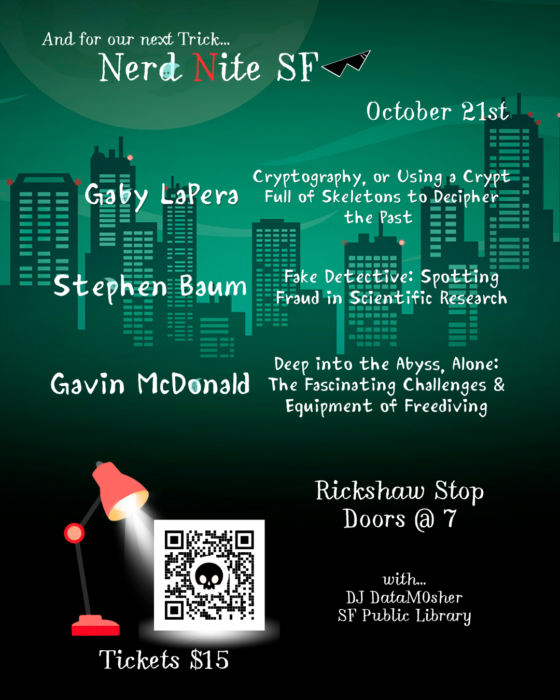
Ah, Fall. The time of year when trees shed their greenery and leave only their skeletons behind, so too does your friendly neighborhood Nerd Nite embrace our spooky side, and what’s more frightening than the end of the Nerd Nite SF 2026 Season? (Jump Scare!) We’re bringing out our best ...
Tsunami early warning systems today rely on models that can take precious minutes to run - minutes that coastal communities don't have. New research is changing that by building a "digital twin" of the earth's crust, one that can simulate the physics of an earthquake and its resulting tsunami in ...
Where: BerkeleyCost: $27
Vanished: Extinct (or Possibly Extinct) Birds of Notrh America and Why Their Stories Matter - LivestreamExtinction is a poignant, fascinating, and important topic in conservation. Join Carolyn Knight and Julie Amato for an introduction to the extinct (and possibly extinct) birds of North America. We’ll define extinction (a surprisingly difficult determination to make); discuss the history and causes of bird extinctions; and share the moving ...