Twenty years after the World Wide Web was created, can we now make it better? How can we ensure that our most important values â privacy, free speech, and open access to knowledge â are enshrined in the code itself? In a provocative call to action, entrepreneur and Open Internet ...
Where: BerkeleyCost: Free
Bringing Nuclear Power to Mars - RESCHEDULEDEstablishing a lunar base is probably a wise first first step to colonizing Mars, and colonizing. Mars will be a giant leap forward for humankind to travel to the stars. We begin our discussion by noting that the bare minimum for sustaining life on the Moon exists in the water brought by comets ...
The emergence of new means of social media in recent years has made way for both utopian and dystopian discourses regarding their impact on the common good in general and on democratization and social participation in public life in particular. This conversation, however, rarely discusses the least advantaged elements of ...
Behavioral and Neural Mechanisms of Depression in Adolescent Romantic RelationshipsRomantic relationships are one of the most salient contexts for adolescents. One of the most unpredictable, intense, and novel stressors revolves around the acquisition, maintenance and dissolution of romantic relationships. Neuroimaging studies consistently show that depressed and anxious adolescents show higher vigilance to social threat cues from unfamiliar peers, exhibiting ...
From bionic limbs and neural implants to prenatal screening, researchers around the world are hard at work developing a myriad of technologies to fix or enhance the human body. Through the perspectives of five people with disabilities - a scientist, journalist, community organizer, bionics engineer, and exoskeleton test pilot - ...
Where: StanfordCost: Free
Beyond Literacy, for Humans and AIsStephen Wolfram is the creator of Mathematica, Wolfram|Alpha and most recently the Wolfram Language, as well as the author of A New Kind of Science. He has spent the past 40 years alternating between technology and basic science.Advance ticketing recommended. See weblink for additional admission information
Where: BerkeleyCost: $0 - $7
The Future of Solar PowerCome hear about the future of the burgeoning solar energy industry from a leader in the field. NextTracker CEO and long-time senior executive in the solar power industry Dan Shugar has spent 28 years advancing renewable energy. As founder and CEO, Shugar has served NexTracker from inception to one of ...
Where: San FranciscoCost: $20 General, $7 for Members, $7 Students
Today's software systems build on open source software. Thus, we need to understand how to successfully create, nurture, and mature the software development communities of these open source projects. In this presentation, we review and discuss best practices of the open source volunteering and recruitment process that successful project leaders ...
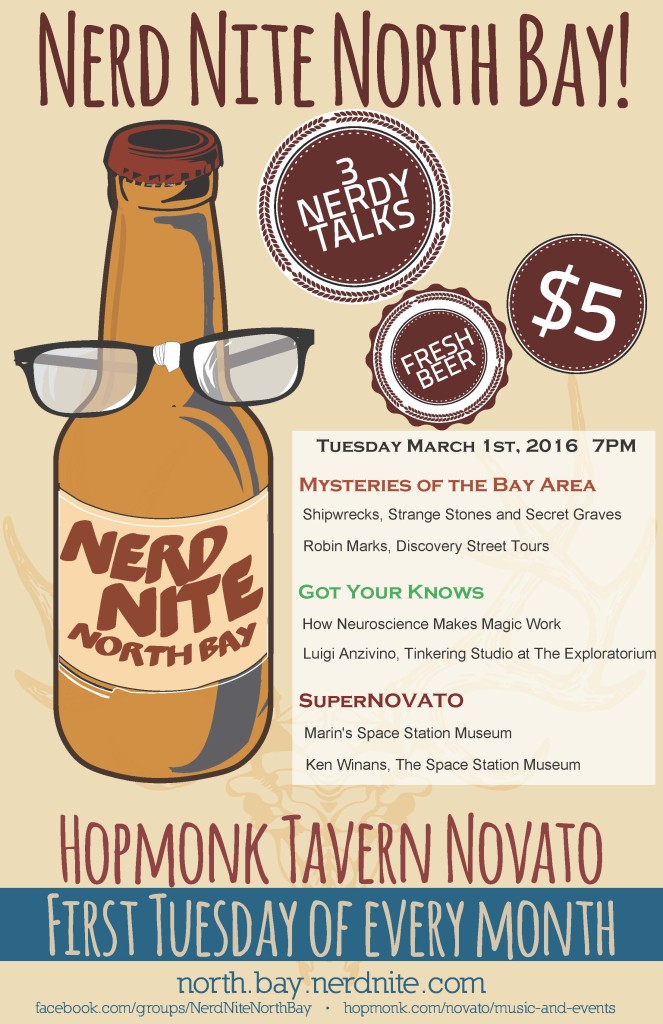
Mysteries of the Bay Area Shipwrecks, Strange Stones and Secret GravesFrom sunken treasure and spaceships to mass graves and massive walls, Nerd Nite brings you more Bay Area unsolved mysteries than Unsolved Mysteries. Get a history of UFO sightings in the Bay Area, hear the grisly details of Evergreen Cemetery's ...
Groundbreaking science now shows that approximately 10 percent of disease is genetic and 90 percent is due to environmental exposures such as the way you eat, move, think and supplement. Gottfried practices functional medicine, a systems-based approach to address health from your DNA to your daily habits.Learn how to optimize ...
Where: Palo AltoCost: $15 General, $10 Member, $8 Student
Polar Windows to Earth's ClimateAlthough they are smaller than a grain of sand, tiny marine plants known as phytoplankton play a surprisingly prominent role in sequestering atmospheric carbon dioxide in the deep ocean. In polar waters, phytoplankton form the basis of the food chain that nourishes everything from penguins to whales. Stanford biological oceanographer ...