
How small-scale animal-fluid interactions have large-scale implications
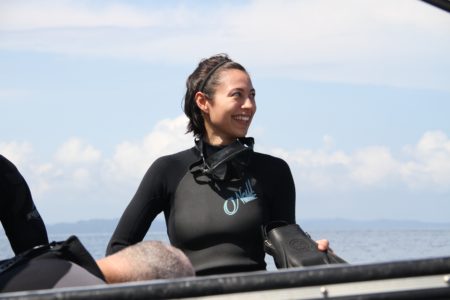
All biological and physical processes in the ocean are governed by the physics of fluid motion. Understanding the constraints that the fluid environment places on organisms is an important step to understanding how marine systems function and how they will respond to a changing ocean. Fluid motion in the ocean cascades from large, global-scale currents to microscale flows generated by swimming zooplankton. While the oceanographic community has successfully developed tools to measure global and mesoscale fluid processes, these methods cannot adequately characterize fluid motion at size scales most relevant to the vast majority of organisms in the ocean. Here, I present efforts to address these technological needs through the development of novel instrumentation: (1) SCUVA (self-contained underwater velocimetry apparatus) and (2) DeepPIV (particle image velocimetry). These technologies have been used to elucidate the ecomechanics of swimming jellyfish and filter-feeding larvaceans, yielding astonishing results that may alter perceptions of how small organisms affect large-scale oceanic processes. Plans to develop next-generation platforms to characterize biological-physical interactions in the ocean will also be presented.
Speaker: Kakani Katija, Monterey Bay Aquarium Research Institute
Wednesday, 01/18/17
Contact:
Website: Click to VisitSave this Event:
iCalendarGoogle Calendar
Yahoo! Calendar
Windows Live Calendar
Monterey Bay Aquarium Research Institute


Moss Landing, CA 95039
US