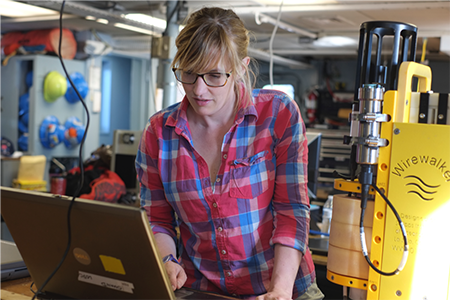
Rapid wave-powered profiling of bio-optical properties from an autonomous Wirewalker platform reveals a high variability (minutes to days) in phytoplankton physiological rates. Highly resolved diel cycles in beam attenuation (a proxy for particulate organic carbon) allow detailed quantification of phytoplankton growth and losses throughout the water column, and for the ...
This colloquium will be given by Associate Professor Leonardo Senatore of the Stanford Institute for Theoretical Physics.
Where: StanfordCost: Free
2D Magnets and HeterostructuresSince the discovery of graphene, the family of two-dimensional (2D) materials has grown to encompass a broad range of electronic properties. However, until recently 2D crystals with intrinsic magnetism were still lacking. Such crystals would enable new ways to study 2D magnetism by harnessing the unique features of atomically-thin materials, ...
We present four new findings regarding the state of knowledge and remaining uncertainties concerning the anthropogenic agents of climate change. These agents include the long-lived greenhouse gases such as carbon dioxide and the short-lived climate forcers including methane and aerosols.  First, using modern laboratory spectroscopy we show that we can ...
SUMMER AT CERNZachary Kurland is a graduating physics student at Sonoma State University. In the summer of 2017, he was awarded the NSF-IRES award to perform research at CERN on the ATLAS experiment of the Large Hadron Collider in Geneva Switzerland for eight weeks. He will be discussing his research, how he ...
Where: Rohnert ParkCost: Free
Droplet Microfluidics: Biology One Picoliter at a TimeThis talk will describe the use of microfluidic technology to control and manipulate drops whose volume is about one picoliter. These can serve as reaction vessels for performing biology experiments. These drops can be manipulated with very high precision using an inert carrier oil to control the fluidic. Small quantities ...
Solar energy, once a niche application for a limited market, has become the cheapest and fastest-growing power source on earth. What’s more, its potential is nearly limitlessâ€"every hour the sun beams down more energy than the world uses in a year. But in his new book, Taming the Sun: Innovations to ...
Where: StanfordCost: Free
Cosmic Collisions Reveal Einstein's Gravitational-Wave UniverseFor the first time, scientists have observed ripples in the fabric of spacetime called gravitational waves, arriving at the earth from a cataclysmic event in the distant universe. This confirms a major prediction of Albert Einstein’s 1915 general theory of relativity and opens an unprecedented new window onto the cosmos. Gravitational waves carry ...