Nina Beguš will present artificial humanities, an interdisciplinary framework using the humanities to thoughtfully approach the development of AI. We will focus on both fictional and historical representations of AI - from Eliza Doolittle to Eliza the chatbot - and reflect on recent product developments in AI and language while ...
White Dwards as Probes of Convective Overshoot and Evolved Exoplanetary SystemsWhite dwards are the stellar remnants left behind by the majority of stars. In 30 - 50% of the population, material such as asteroids, comets, moons, and even planets from their disrupted planetary systems can be identified by metal absorption lines detected in the white dwarf atmosphere. These stellar remnants ...
This presentation will trace the remarkable journey of Atomic Force Microscopy (AFM) from its invention in 1985 by G. Binnig, C. F. Quate, and Ch. Gerber at Stanford University - during my time as a graduate student under Prof. Quate - to its current role as a critical tool in ...
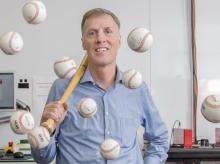
Most sporting activities involve a ball. In comparison to the impacting device (bat, club, racket, paddle, etc) the ball is consumable and tends to receive relatively little attention. Yet the ball is complex, inelastic, highly non-linear, and is an integral part of determining equipment performance. This presentation will consider mechanisms ...
Continuous approximation modelling is a logistical paradigm with origins at UC Berkeley in which detailed operational data is replaced by statistical summaries to analyze large-scale routing and distribution problems. This presentation introduces some new applications of computational geometry and geometric probability theory to study modern problems in last-mile delivery, districting, ...
More than a century ago, Albert Einstein presented his general theory of gravitation. One of the predictions of this theory is that not only particles and objects with mass, but also the quanta of light, photons, are tied to the curvature of space-time, and thus to gravity. There must be ...