
The LSST Camera and Mission in Focus
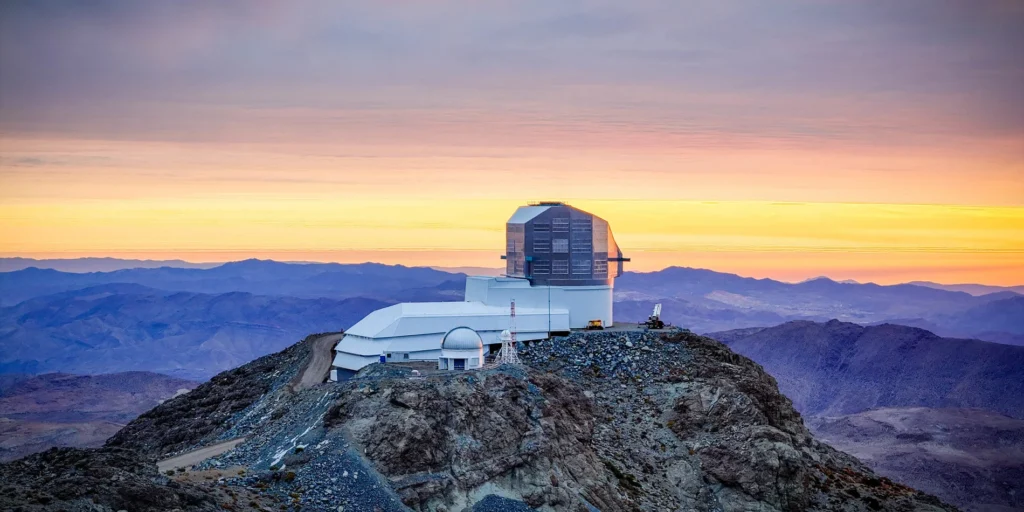
The NSF-DOE funded Vera C. Rubin Observatory’s Legacy Survey of Space and Time (LSST) is a 10-year survey of the southern sky at the Vera C. Rubin Observatory, located on the El Peñon peak of Cerro Pachón in northern Chile. LSST officially began on June 30, 2026, marking the start of a decade of survey data that will enable researchers around the world to better evaluate a wide range of pressing questions about the attributes of dark energy and dark matter, the formation of the Milky Way, the properties of small bodies in the solar system, the trajectories of potentially hazardous asteroids and the possible existence of undiscovered explosive phenomena.
The telescope at the Rubin Observatory is the Simonyi Survey Telescope (SST), and the heart of the SST is the LSST Camera. It uses three refractive lenses to illuminate a 9.6-square degree field of view, and is the largest digital camera ever constructed. In full survey operations, the camera takes a pair of 15-second exposures of each field, scanning the sky throughout the entire night.
In this presentation, Dr Andrew Rasmussen, who since 2021 has had a leading role in the camera as the chief scientist for the LSST camera’s Integration and Test (I&T) team, will focus our attention on the LSST camera’s design and challenges overcome in its commissioning, as well as a variety of the cutting edge science initiatives that the LSST camera is enabling, images, and challenges such as managing the volume of data being collected.
Friday, 09/04/26
Contact:
Website: Click to VisitCost:
FreeSave this Event:
iCalendarGoogle Calendar
Yahoo! Calendar
Windows Live Calendar
College of San Mateo Bldg 36


San Mateo, CA 94402
USA