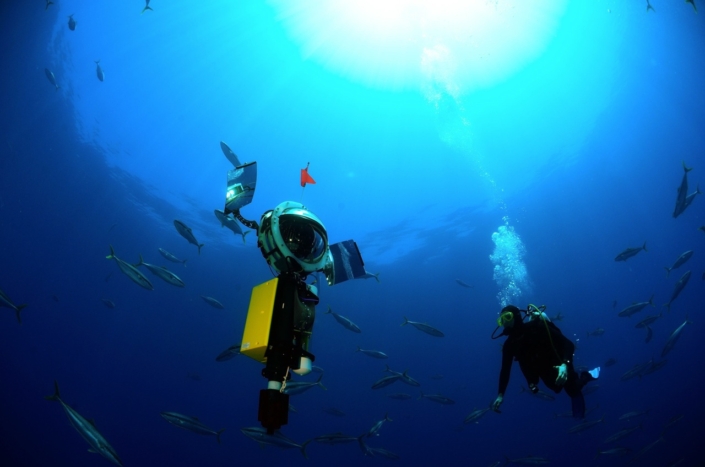
Midwater ecosystems are the most substantial on Earth, containing swimming fishes, crustaceans, cephalopods, and gelatinous organisms. These animals live in perpetual twilight and inhabit an important position within oceanic food webs, forming dense vertically migrating groups. These daily migrations are critical to the ocean’s ability to absorb atmospheric carbon. Techniques ...
Where: Cost: Free
Historical role of fire and land management in the Klamath Mountains, California - LivestreamIn this talk, Dr. Clarke Knight, USGS, will discuss her most recent paper from the Proceedings of the National Academy of Sciences. Dr. Knight, along with co-authors from the Karuk and Yurok Tribes, found strong Indigenous influence on forest conditions in the Klamath Mountains over the last millennium. As restoration ...
How do scientists go from OMG to PhD? How do they turn their passion for science into their profession? What advice do they have for future scientists?If you are a 5th-12th grade student, undergraduate, teacher or parent, join us to ask these questions and more in a Q&A session with ...
Phytoplankton organisms are fascinating and can be considered a benefit or a nuisance for the economy. In this seminar, I will present my research at BahÃa Fosforescente, where dense populations of bioluminescent phytoplankton (i.e., Pyrodinium bahamense) have made this ecosystem an important tourist attraction in Puerto Rico. However, fluctuations with ...
Grounds for ScienceGrounds for Science, our public program featuring Cal STEM graduate students, is back live & in-person! Join us as we launch our collaboration with MudLab, a cafe and store with a mission: to envision and build a world beyond waste.Speaker: Jessica Heiges, UC Berkeley
Where: OaklandCost: Free
To eat or not to eat? Is that the (only) question? How environmental chemicals contribute to obesity - LivestreamMultigenerational disease research has shown links between some non-communicable diseases, their environmental origin, and lifestyle decisions our ancestors made. Defining those links will provide us with a better understanding of how our life choices can help preserve the health of our descendants. Raquel Chamorro-Garcia, assistant professor of microbiology and environmental ...