Before you can trim your carbon footprint, you need to measure it.Every decision you make - what you eat, what you wear, how you travel - has a quantifiable environmental impact. The methodology to measure it is called life-cycle assessment. It’s messy. For example, the environmental impact of burning natural ...
Where: StanfordCost: Free
Fungus Among Us NightLifeMagic Mycology (African Hall)7:30pm, Enter the wonderful world of mushroom foraging with Debbie Viess of the Bay Area Mycological Society - and learn how and where to find fungi, why it’s important to study them, and why they’ve kept her fascinated for so long.  8:30pm, Discover the power of psilocybin, ...
Where: San FranciscoCost: $15 General, $12 Members
Is Silicon Valley As Green As It Claims?Tech companies are cleaning up their data centers and building shiny new buildings that sip water and energy. But are these companies really as green as they claim to be? How do we know they aren’t just greenwashing? Many tech and industrial companies have issued statements in support of the ...
Where: San FranciscoCost: $20 General, $15 Members, $7 Students
Neuroscience has built a case for addressing many of the Great Questions (You & Me, Animals & People, Free Will & Determinism, Nature & Nurture, Art & Science, Life & Death) as interdependent feedback loops. In this presentation, Dr. Stephens will discard the old left brain as accountant / right ...
Where: BerkeleyCost: Free
Friday, 01/12/18
Fern FridayMeet the ferny sporophytes of nine local fern species on an excursion along Pine Flat Road with ACR Education Specialist Dave Self. We’ll also take a short hike (two miles) to visit the ridgeline serpentine of Red Hill to find our tenth and last species and to see if we ...
Where: GeyservilleCost: $20 General, $15 Members/Students, Free < 18
Conservation Efforts and the Building of the Nature State: A Colombian CaseA swath of tropical forest on Colombia´s Caribbean coast, along with the felines and people who inhabit it, are manifestations of what we can call the nature state. This novel concept refers to the set of institutions, practices, and policies by which the state claims that caring for nature, and ...
Where: StanfordCost: Free
Green Friday - 'Project Drawdown: The most comprehensive plan ever proposed to reverse global warming'In this DVD lecture by preeminent environmentalist and thinker Paul Hawken we learn of the strategies put forth in his book, Drawdown, a comprehensive list of one hundred ways to approach and solve the crisis of global warming. Paul Hawken is an environmentalist, entrepreneur, author and activist who has dedicated ...
Where: BerkeleyCost: $3 donation requested
Free Public StargazingView Moon, bright planet â€" Venus, red planet â€" Mars, Pleiades (Seven sisters or Subaru), Andromeda Galaxy, Orion Nebula , Crab Nebula , Double cluster in Perseus, star cluster Hyades, Pleiades, “Owl†cluster, Beehive cluster, bright stars Rigel, Betelgeuse, Sirius, Aldebaran and many more objects.Facility has an 8 inch refractor ...
Where: San JoseCost: Free
The History of the Reflecting TelescopeThe reflecting telescope was invented by Sir Isaac Newton, and proposed by a few others in the late 17th Century in an effort to solve the problem of chromatic aberration that was plaguing refractors of the time. These early reflectors used metal mirrors made from a highly reflective metal alloy ...
Visit the botanical art exhibit "Celebrating Trees", take a walk to discover the trees of the UC Botanical Garden, particularly those that are nesting sites, and learn about the winter birds of the Garden. We'll also talk about nest materials and see some real bird nests up close! Make a ...
Look for birds, mammals, and animal tracks as we explore along the water’s edge on this 3.7-mile nature walk. Bring binoculars and your favorite field guide to help enjoy the views. Have at least one liter of water, snacks, and appropriate clothing. Rain cancels hike. Led by Steve Stolper. RESERVATIONS ...
Where: AlvisoCost: Free
Salt Marsh WalkTake a walk with docent Gregg Aronson around the wetlands of the wildlife refuge and learn about their history. See examples of salt collection ponds and learn what is being done to convert them back to their original, natural salt marsh state. Hear how wildlife is affected by the two types of habitat, and why it ...
Where: FremontCost: Free
Fixit Clinic CCXLVI (246) Oakland CAFixit Clinic CCXLVI (246) Oakland CAFixit Coaches will be training in residence at the Oakland Public Library, Dimond Branch and available for consultation on your broken items.Celebrating repair by conveying basic troubleshooting skills, Fixit Clinics are do-it-together hands-on STEM-oriented fix-n-learn community-based exploration and discovery workshops staffed by volunteer Fixit Coaches ...
Where: OaklandCost: Free
Twilight Marsh WalkExperience the salt marsh at twilight on an easy stroll along Tidelands (1 1/3 mile) Trail. At the setting of the sun we will observe the beginning of nature’s night shift. Come discover the sights, sounds, and smells of the refuge as night descends. Not suitable for young children. RESERVATIONS ...
Where: FremontCost: Free
Sunday, 01/14/18
Documenting Wildlife on the MayacamasSpend the morning learning about some of the wildlife that inhabits the Preserves with Ginny Fifield, Wildlilfe Camera Specialist, ACR Mountain Lion Project Team, and Modini Mayacamas Preserves Volunteer. We’ll learn about identifying field signs of mountain lions, bobcat, coyotes and more. Based on what we find, we'll guess what ...
This month we celebrate the animals that are the champions of the cold: Animals of the Arctic. We recommend teaming our free classroom program with a Docent-led tour at 11am, 1pm or 3pm for a truly immersive marine mammal experience.Program SummaryFREE Classroom Programs: Animals of the Arctic- 12 PM and ...
CuriOdyssey is home to the Bay Area FrogWatch chapter. Since 2011, the Bay Area chapter has been monitoring our six local species: the Pacific treefrog, the red-legged frog, foothill yellow-legged frog, the western toad, the western spadefoot toad, and the bullfrog.FrogWatch USA was established in 1998 and adopted by the ...
Where: San MateoCost:
Tuesday, 01/16/18
Two KIPAC Tea TalksSolving a puzzle about halo assembly biasSpeaker: Yao-Yuan Mao, University of PittsburghPrecision cosmology with 21cm intensity mapping in the post-reionization eraSpeaker: Francisco Villaescusa-Navarro, Flatiron CCA
Where: StanfordCost: Free
Symmetries of TimeAstroPhysics/Physics ColloquiumSpeaker: Frank Wilczek, MIT
Where: StanfordCost: Free
An Evening with the San Francisco Amateur AstronomersJoin us in our 66th year for a special evening with SFAA. Enjoy extra time for snacks and meet & greet, as we share our experiences with you in a more informal setting.Hear short talks on what is in the future for amateur astronomy, discover how to share your dark ...
Where: San FranciscoCost: Free
Wednesday, 01/17/18
Biotechnology Vendor ShowcaseLearn about the latest research tools at the Biotechnology Vendor Showcaseâ„¢ event happening at the University of California, San Francisco, Mission Bay! This complimentary event is for active research scientists and related life science professionals interested in viewing the latest products and meeting with scientific suppliers.Â
Where: San FranciscoCost: Free
Making do under low dissolved oxygen: Microbial ecology and biogeochemistry in low-oxygen marine ecosystemsOcean deoxygenation and oxygen minimum zone (OMZ) expansion have profound implications for marine ecology and biogeochemistry. However, a missing link in our understanding of ocean deoxygenation is accurate measurement and modeling of those processes and organisms that are ultimately responsible for consuming dissolved oxygen (DO) in the ocean. Aerobic microorganisms catalyze the ...
Climate engineering (CE) - intentional, global-scale modification of the environment to offset some of the effects of elevated greenhouse gases - appears able to reduce climate-change risks beyond what is possible with mitigation and adaptation alone, including enabling integrated climate-response strategies that reduce risks in ways not otherwise achievable. Moreover, ...
Retrieval systems like internet search still use the same underlying keyword-based index they used back in the 1990s. Dan Gillick will describe his research on building a new kind of retrieval system based, somewhat unsurprisingly, on neural networks. Heâll try to explain the key pieces of technology and discuss how ...
A key question in climate science is How much global warming should we expect for a given increase in the atmospheric concentration of greenhouse gasses like carbon dioxide? One strategy for addressing this question is to run physical models of the global climate system but these models vary in their ...
Where: StanfordCost: Free
The Parallel Future of the BrowserThe browser needs to get faster. The first browser was created almost 30 years ago. Since then, the browser has moved from its past as a simple document viewer towards a future as a fully-featured application platform. But those applications are testing the limits of current browsers, especially on devices ...
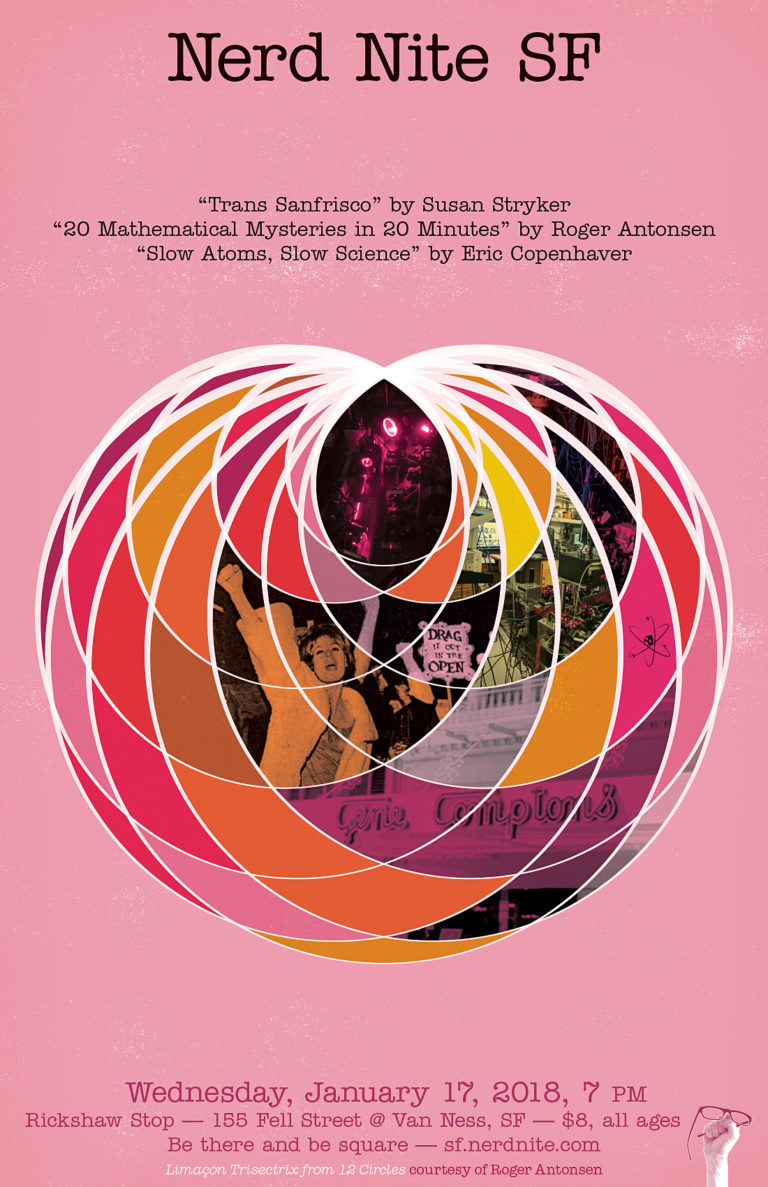
A gender scholar, a mathematician, and a physicist walk into a bar… that can mean only one thing: It’s a new year of Nerd Nite! That bar is the Rickshaw Stop - located at the intersection of trans history, surreal math, and “artisanal†physics - and we have three stable ...
Biotechnology Vendor ShowcaseLearn about the latest research tools at the Biotechnology Vendor Showcase™ event happening at the University of California, San Francisco, Parnassus! This complimentary event is for active research scientists and related life science professionals interested in viewing the latest products and meeting with scientific suppliers.
Where: San FranciscoCost: Free
Understanding Black Hole and Galaxy Co-evolution using the “COSMOS†- CANCELEDObservations indicate that supermassive black holes (SMBHs, 10**6-10**9 Msun) dwell at the centers of most local galaxies. Scaling relations between SMBH mass and several large-scale properties of the host galaxies point to a co-ordindated growth of galaxies and their central engines over cosmic time: they "co-evolve". Who is the leading ...
Where: Menlo ParkCost: Free
Cybersecurity Panel: How Technical Talent Will Determine the Future of DemocracyThere is a critical need for technical talent in the public sector to keep our systems secure and save lives. This panel, moderated by journalist Ted Koppel, brings together students and interns at Army Cyber Command with panelists from the military and academia to discuss how to engage the best ...
Occupational therapists (OTs) are critical players in the transdisciplinary rehabilitation team. An OT's job is to help people, who because of illness, injury, or aging, have experienced a decrease in their ability to function independently in the areas of daily living, work, play, and leisure. Treatment by an OT often ...
Where: StanfordCost: Free
Gene Editing and the Unthinkable Power to Control EvolutionUC Berkeley biochemist and IGI Executive Director Jennifer Doudna will join oncologist Siddhartha Mukherjee to discuss unprecedented advancements in genome editing and the effect new technologies will have on the future of humanity.Register here.Â
Where: BerkeleyCost: Free
Having Natural Conversations with Our ThingsWhen and how we interact with technology is steering us toward conversation with our devices. Being able to talk to systems like our cars or our appliances brings all kinds of new, maybe even unthinkable, possibilities. Researchers and designers are imagining Conversational User Interfaces (CUIs) as a new paradigm in ...
"Not too hot, not too cold" begins the prescription for a world that's just right for life as we know it. Finding evidence of life beyond Earth is one of the primary goals of science agencies around the world thanks in large part to NASA's Kepler Mission which launched in ...
Where: Palo AltoCost: Free
Decarbonizing America's Electricity InfrastructureAmerica’s electricity infrastructure is aging. Mason Willrich will describe the ownership and operation of this infrastructure and the web of state and federal policies that govern it. He will present a coherent national strategy for modernizing our infrastructure, including expansion of energy efficiency, wind, solar, nuclear and other carbon-free resources for power ...
Where: San FranciscoCost: $20 General, $8 Members, Free for Students
Everything Matters: Iron 8:00 p.m.Earth’s most common element by mass, iron has been employed since antiquity to create tools, weapons, and works of art. Join master blacksmith James Austin to explore iron’s historical importance and amazing metallurgical properties as well as the air of mystery surrounding the blacksmithing trade.Cinema Arts: The ...
Where: San FranciscoCost: Free with After Dark Admission
Sketchfest NightlifeSF Sketchfest is back at NightLife for a knee-slapping night of creatures, cocktails, and comedy as part of the 17th Annual SF Sketchfest Comedy Festival.Join us for a night of irreverent science, featuring a live version of the comedy podcast “This Week in Science,†and an interactive game called “Thinkers ...
Where: San FranciscoCost: $15 General, $12 Members
There is an air of mystery about the Kingdom of Bhutan, nestled in the rugged Himalayas, where legends of dragons and yetis abound. Despite being sandwiched between the world’s two most populous countries, it maintains a fierce independence and a unique culture deeply rooted in its Buddhist heritage. Bhutan is ...
Where: BerkeleyCost: $5 General, Free for members
Chronic Fatigue Syndrome: An Unfolding Story of Scientific Discoveries and Future Targeted Treatments Chronic Fatigue Syndrome (CFS) is a complex, multifaceted disorder characterized by extreme fatigue and a host of other symptoms that can worsen after physical or mental activity, but do not improve with rest. This presentation will discuss clinical implications of recent scientific reports that are pinning down the development of ...
Where: Palo AltoCost: Free
Gravitational Waves - the New Cosmic MessengerOn September 14, 2015, the Laser Interferometer Gravitational-wave Observatory (LIGO) measured gravitational waves from the merger of two black holes, kicking off a new era of gravitational-wave astronomy. This was the first direct measurement of gravitational waves - ripples in space-time that Albert Einstein predicted 100 years ago in his general theory of relativity. ...
Where: LivermoreCost: $32 - $40 Adults, $12 Students
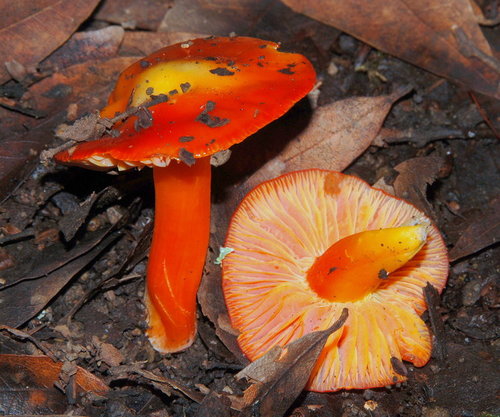
Hunting by Habitat (Mushroom Season Is Year Round In California)Kingman Bond-Graham presents: Hunting by Habitat (Mushroom Season Is Year Round In California); what, when, where, and how to look for mushrooms in Northern California. He has found mycological activity almost everywhere he goes. Edible mushrooms pop up in some expected and unexpected places. Kingman will talk about targeting the ...
Where: BerkeleyCost: Free
Friday, 01/19/18
Winter Bird WalkJoin us as we search for flocks of winter sparrows, bright yellow warblers, and perhaps and elusive red sapsucker. We also hope to welcome some of our earliest migrating hummingbirds back to the garden this month! Led by Ornithologist Chris Carmichael.
Where: BerkeleyCost: $20 General, $18 Members
Traffic Congestion Control: A PDE backstepping perspectiveControl of freeway traffic using ramp metering is a "boundary control" problem when modeling is approached using widely adopted coupled hyperbolic PDE models of the Aw-Rascle-Zhang type, which include the velocity and density states, and which incorporate a model of driver reaction time. Unlike the "free traffic" regime, in which ...
Learning to Read (the Landscape) Join ACR Education Specialist Dave Self and start learning how to read the landscape of the Modini Mayacamas. The reading is challenging and is rarely precise, but it’s all around us: in the distribution, size and shape of trees and shrubs; the size and shape of lichen on the rocks; ...
Where: GeyservilleCost: $20 General, $15 Members/Students, Free < 18
Lichen BioBlitzCalling all Lichen Enthusiasts! Lichens are intriguing composite organisms formed through symbiosis between fungi and cyanobacteria/algae. Like plants, lichens photosynthesize and - also like plants - they flourish here at the Garden! While lichens can be found throughout the year, they are particularly striking during winter months. As ...
Where: San FranciscoCost: Free (RSVP required)
Quicksliver History HikeExplore what remains of the once-bustling mining operations in the hills above New Almaden on this 4-mile hike. Meet at the Wood Road entrance off Hicks Road. Bring water and a snack. Questions?  (408) 918-7770    ​​
Where: San JoseCost: Free
Family Bird WalkLet family walks become a shared time of nature learning. We’ll begin by helping kids create their personal bird watching field guides, and then head out onto the trails to find those birds. A limited number of binoculars are available to borrow. Recommended for children ages 5-10. RESERVATIONS REQUIRED. Register ...
Where: FremontCost: Free
Science at Cal Lecture- Visualizing Biological Molecules: Understanding Life’s PrinciplesAssemblies of biological macromolecules (proteins, DNA, RNA) are the functional units of cells and ultimate the whole organism. Visualizing these macromolecules, in different functional states, provides unique information on how they work and how they fail in the diseased state, and therefore can guide us in the design and improvement ...
Where: BerkeleyCost: Free
Fixit Clinic CCXLVII (247) Fremont CAFixit Clinic CCXLVII (247) Fremont CAFixit Coaches will be training in residence at the Oakland Public Library, Dimond Branch and available for consultation on your broken items.Celebrating repair by conveying basic troubleshooting skills, Fixit Clinics are do-it-together hands-on STEM-oriented fix-n-learn community-based exploration and discovery workshops staffed by volunteer Fixit Coaches ...
Where: FremontCost: Free
Fluxations in Static Blue - Art Exhibition and receptionSausalito based artist Bret Arenson will be exhibiting the large scale work, Fluxations in Static Blue, which will span the entire main wall of the exhibit area. This immersive ambient work, done through ecstatic automatism, invites the viewer to discover flow and movement within what otherwise might be considered static ...
Where: SausalitoCost: Free
Is Quantum Entanglement Magic?Dr. Ken Wharton is a professor of physics at San Jose State University. His research is in the field of Quantum Foundations, where he tries to make sense of phenomena like entanglement without giving up conventional notions of space and time. He also makes an effort to explain Quantum Foundations ...
Where: OaklandCost: Free
Sunday, 01/21/18
Gray Whale Watching with Sanctuary ExplorationsWitness the mighty gray whale migration on this half-day cruise. Join our sanctuary naturalists as we venture into the southbound migration path of the gray whale as they head through our marine sanctuaries, traveling from Arctic feeding grounds to Baja California breeding grounds. Learn about their natural history, their recovery ...
Before there were mammals on land, there were dinosaurs. And before there were fish in the sea, there were cephalopods - Earth’s first truly substantial animals and the ancestors of modern squid. With dozens of tentacles and formidable shells, they presided over an undersea empire for millions of years.Join scientist ...
Where: Santa CruzCost: Free with admission
Made for Movies: From Poltergeist to Pirates of the CaribbeanHow do you craft a seaworthy ship - to scale? Or scatter tiny raindrops on a miniature dock? Lorne Peterson shares stories from his years at Industrial Light & Magic, such as creating foam rocks that behave like real ones in Wild Wild West, or coaxing a model house to ...
Where: San FranciscoCost: Free with Admission to the Exploratorium
Monday, 01/22/18
Tests of Cosmological GravityModern theories of dark energy can be epitomized by two words: modified gravity. In this talk I will discuss a popular and well-motivated model for dark energy, galileon gravity, and how it can be constrained using two novel astrophysical probes. The first, is the absence of offset black holes in ...
Where: StanfordCost: Free
Law, Order, and AlgorithmsData and algorithms are increasingly used in the criminal justice system, from tracking individuals with aerial cameras to deciding which defendants to release on bail. These developments offer the promise of greater efficiency and equity, but also pose serious challenges for traditional notions of privacy and fairness. I'll describe some ...
Rechargeable batteries are porous electrochemical structures composed of secondary particles, which are aggregates of single crystal primary particles, pores, cracks, and processing-induced phases and features. The underlying meso and microstructural topology, including its size, size distribution, morphology and crystallographic orientation of each of the underlying phases impacts the delivered power and energy density. While ...
Where: StanfordCost: Free
One Water Approach to Urban Water ManagementTo kick off 2018, at the next Landscape Advisory Committee meeting, Rosey Jencks (Vice President of One Water-Norcal, Brown and Caldwell)Â will present the One Water concept, an integrated planning and implementation approach to manage finite urban water resources.This collaborative approach, involving a wide variety of stakeholders, breaks down barriers separating ...
Where: OaklandCost: Free
Einstein, Gravitational Waves and a New ScienceAlbert Einstein predicted the existence of gravitational waves 100 years ago, but the effects are so tiny that even Einstein thought they could never be detected. After 40 years of controversy, theorists finally developed a consensus that they really do exist. Then the problem became whether experimental physicists could develop ...
Where: Menlo ParkCost: Free
People and Robots SeminarContinuum manipulators are a class of long, slender soft robots that can be employed for minimally invasive surgical procedures such are cardiac cath eterization, colonoscopy, and bronchoscopy. The soft nature of these devices introduces uncertainty in modeling both due to the deformable nature of the manip ulator and the environment. ...
John Deutch is an Institute Professor at the Massachusetts Institute of Technology. Mr. Deutch has been a member of the MIT faculty since 1970, and has served as Chairman of the Department of Chemistry, Dean of Science, and Provost. Mr. Deutch has published over 160 technical publications in physical chemistry, ...
Where: StanfordCost: Free
AI in the Clouds: Data, ML and AI in the new world of software in the CloudIn the recent years we have seen how Data Science, Machine Learning, and AI, in general, have been influencing and rewriting the rules in everything from commerce to healthcare to finance. Additionally, deploying to the cloud and has opened new opportunities for collecting and using data. We have quickly moved ...
Where: Santa ClaraCost: Free
An Evening with MacArthur Fellows: Breaking Down Barriers to STEM EducationScience, technology, engineering and mathematics (STEM) jobs are projected to grow 17 percent between 2014 and 2024 compared to just 12 percent for non-STEM related fields. Many of those jobs will reside right here in Silicon Valley. That’s the good news. The bad news is that despite progress, minorities, women ...
Where: Palo AltoCost: Free
Science Vs Cinema: 'GALAXY QUEST'Science Vs Cinema is a new monthly series exploring the awesome science behind your favorite movies. We'll explore what's right, what's wrong, and why the scientist always seems to be the first one to die in so many films. Get ready for a way-too-deep dive into the science - from ...
Where: San FranciscoCost:
Tuesday, 01/23/18
Two KIPAC Tea TalksGalaxy colors and halos - signatures from velocity spaceSpeaker: Susmita Adhikari (KIPAC)Polarimetry of Exoplanetary SystemsSpeaker: Max Millar-Blancher, JPLÂ
Where: StanfordCost: Free
Disruptive Transportation and the Future of the CityTransportation network companies (TNCs) such as Uber and Lyft are dramatically changing the way we travel today. However, everyone suffers if we don’t proactively plan for the ripple effects of their increasing ubiquity, not to mention the impacts caused by autonomous vehicles. Come learn how the growth of TNCs is ...
Where: San JoseCost: $10 General, Free for Members
Adaptive management is an iterative approach to natural resource management, which evaluates a natural system and responds to new data. It enables action and decision-making in real-world scenarios.While the principles of adaptive management are well known in environmental systems management, there's a lesser-known kind of adaptation going on behind the ...
Where: San FranciscoCost: Free, RSVP Required
Dooley and Pelosi: Bridging Trump’s Divide - RESCHEDULEDDebbie Dooley helped organize the Tea Party’s first national demonstration in 2009 and until recently was on the board of the Tea Party Patriots. She enthusiastically supports Donald Trump, defends Roy Moore and despises the “Bush cabal.†But her views transcend typical partisan boundaries. She loathes the Koch brothers, thinks solar ...
Where: San FranciscoCost: $20 General, $12 Members, $7 Students
Join us for a special SETI Talk on 1I/`Oumuamua, the first known interstellar small body, possibly an asteroid which is probably coming from another planetary system. Its recent discovery by Pan-STARRS1 offers a rare opportunity to explore the planetary formation processes of other stars, and the effect of the interstellar ...
RESCHEDULED TO 1.30.18Dr. Baldo Marinovic, a research biologist at Institute of Marine Sciences, University of California, Santa Cruz studies zooplankton ecology and the dynamics of ocean food webs. MS Marine sciences UCSC, PhD Zoology University Western Australia.Since 1997, he has been conducting surveys in Monterey Bay to understand what determines ...
Over the past 18 years I have worked in the Jaffe Laboratory for Underwater Imaging on building acoustic and optical in situ sensing systems. A central theme of this work is building instruments that provide detailed information about individual organisms while leveraging advances in industrial technology. In this seminar, I’ll ...
Future growth in urbanization will mainly occur in cities of the rising south. UN Habitat reports that in the past decade, the urban population in emerging economies grew on average 1.2 million people per week. By 2050, it is expected that seven out of ten people will be living in ...
Where: BerkeleyCost: Free
Cosmic Gold: Neutron Star Mergers, Gravitational Waves, and the Origin of the Heavy ElementsScientists have recently developed a new way to `see' the universe, using the gravitational waves predicted by Einstein nearly a century ago. These waves can teach us about some of the most exotic objects known, including star “corpses†known as black holes and neutron stars.  Remarkably, they have also helped ...
If ye value critical thinking, and if ye scorn the flim-flam man, join us, your friends. We are a group who informally discuss the latest in science or pseudoscience over good eats & ale. Sponsored by Bay Area Skeptics.WHY: Because we’re curious creatures.
Where: MillbraeCost: Free
ExoplanetsMarin Science SeminarSpeaker: Warren Wiscombe, NASA Goddard
Where: San RafaelCost: Free
Kepler's Literary Foundation Presents Michael ShermerMichael Shermer is the Founding Publisher and Editor-in-Chief of Skeptic magazine. He is the author of Why People Believe Weird Things: Pseudoscience, Superstition, and Other Confusions of Our Time, How We Believe: The Search for God in an Age of Science, and Denying History: Who Says the Holocaust Never Happened and Why Do They Say It? (with ...
Surfing Mavericks: Call of the Data Join Exploratorium educator Lori Lambertson, an avid surfer, for a talk about the data and weather forecasting that goes into calling the Mavericks surf contest and the unique features of the famed break. This exciting big-wave contest, held 25 miles south of San Francisco, requires perfect conditions that only come ...
Think global, #TravelLocal? Harnessing social media for sustainability.  Every year, 124 million Americans take vacations. They’re traveling farther than ever, averaging 1,200 miles per trip. Transportation -- particularly airplane travel -- is a leading source of greenhouse-gas emissions. But can blurring the status signal associated with long distance travel lead ...
Where: StanfordCost: Free
Issues of Human Interface DesignGary will present some challenges of human interface design, using prosthetic limbs as the springboard for discussion.Speaker: Gary Berke, prosthetist and an Adjunct Clinical Assistant Professor and Director of Prosthetics in Stanford's Department of Orthopaedic Surgery
Where: StanfordCost: Free
A Life Among Fishes: The Art of GyotakuJoin us as Christopher Dewees presents his book, A Life Among Fishes: The Art of Gyotaku, sharing a half century of printing fish and shellfish to full color. We will follow Chris's evolution from being exposed and fascinated by gyotaku as a graduate student, to his status now as an internationally recognized ...
 The ShakeAlert earthquake early warning system will begin limited operations this year.Alerts could save lives and properties but several challenges remain.With millions at risk, why isn't full public alerting happening yet?Speaker: Douglas Given, USGS
What's going on inside the nucleus of an atom? Why does it spit out radiation? Did you know that you are exposed to radioactivity every day? Learn the facts about this somewhat controversial topic.Part of After Dark (6:00 - 10:00)
Where: San FranciscoCost: Free with After Dark Admission
The way you sense the world around you is very different from how the spider on the web on your porch experiences its world. In fact, the senses used by that spider on the web are very different from the senses of the jumping spider hopping around your garden. At ...
It is more apparent every day that science informs international cooperation and relations. We need our future leaders to be prepared for this reality. This is a great opportunity for 12 to 90 year olds to learn together.The world has just made its biggest ever promise to itself. Our leaders ...
Where: BerkeleyCost: see website
Fire on the MountainJoin ACR Education Specialist Dave Self as we look for evidence of fire and its effects on the landscape. You’ll learn about fire in the geologic past and the use of fire as a tool employed by Native cultures in the management of useful plants and habitats. We will also discuss ...
Where: GeyservilleCost: $20 General, $15 Members/Students, Free < 18
Marin Pollinator WorkshopMMWD and San Francisco State University have begun inventorying pollinators, primarily bees, on the mountain this spring. This will be the first time this part of Marin has ever been surveyed for pollinators. Researchers will also generate a historical species list and review plant species currently known to be extirpated ...
Where: Corte MaderaCost: Free
Back in Time18,000 years ago there was no San Francisco Bay Estuary and the delta was in a whole different location. Watch an accelerated time lapse and see how one of the world’s largest natural estuaries and one of the few inverted deltas on the planet were created. You will see how ...
Where: SausalitoCost: Free
Science Saturday: Amazing MigrationsWe peer into the fantastic world of wildlife migration. We will also be celebrating Sandy the Whale's birthday, and are excited to host Larry Foster - the artist who made Sandy - for a talk and Q & A about the beloved whale on the Museum's front porch. Kids and ...
Where: Pacific GroveCost: Free
Whalefest Monterey SymposiumRunning in conjunction with Whalefest Monterey at the Old Monterey Wharf, a 2-day symposium is being held. See weblink for speakers and abstracts, as well as additional information.
Where: MontereyCost:
Agar Art Contest 2018 - Learn How to Make Bacterial ArtCounter Culture Labs is proud to be hosting the American Society for Microbiology Agar Art Contest.Come and learn how to make colorful and unique living art. Design your own art piece using our colorful bacteria and then submit your piece for a chance to win.We will be hosting several workshops, ...
Where: OaklandCost: $20
Outfall TourHave you ever wondered where your indoor water ends up? If you live in the south bay, it probably goes to the San Jose- Santa Clara Regional Wastewater Facility to be cleaned. Join us on a tour of the Facility’s Outfall and see firsthand how it helps keep the San ...
Do you sometimes see paw prints in mud or scat (poop) on the trails and assume that a dog left it? It could be from something else. Come along with me and I will show you how to distinguish and identify the markings of a gray fox. Gain some insights ...
Join us for a new presentation by renowned photographer Frans Lanting and his partner, Chris Eckstrom, about the wonders of wild Africa. During many journeys over the past 30 years, they have documented the wildlife and natural heritage of some of the most celebrated landscapes on earth.INTO AFRICA is based on ...
Where: Santa CruzCost: $25 General, $20 Seymour Center members
Oceans Aglow: Family Night Hike & CampfireJoin NatureBridge Golden Gate as we discover one of the most amazing natural phenomenon, bioluminescence. We will hike out to Rodeo Beach and explore the sands for twinkling plankton. Where did they come from? Why are they blinking? Are they here all the time? We will try and answer all ...
Where: SausalitoCost: $15 per person
Jazz Under the StarsCome peer through our telescopes and see craters on the Moon, the visible planets, star clusters, and more while we listen to CSM's very own KCSM Jazz 91 FM. Dress warmly. Free parking in Marie Curie Lot 5. Directions are available on the Maps, Directions & Parking page.
Join us for a new presentation by renowned photographer Frans Lanting and his partner, Chris Eckstrom, about the wonders of wild Africa. During many journeys over the past 30 years, they have documented the wildlife and natural heritage of some of the most celebrated landscapes on earth.INTO AFRICA is based on ...
Where: Santa CruzCost: $25 General, $20 Seymour Center members
San Francisco City Star PartyCome join us for our monthly San Francisco City Star Party. SFAA members provide telescopes for your viewing pleasure. Be sure to check the SFAA website for the latest updates…bad weather or overcast skies will cancel!
Where: San FranciscoCost: Free
Sunday, 01/28/18
Sunrise Tour of Muir WoodsYou are cordially invited to attend a sunrise guided tour through Muir Woods National Monument. While the early hour may seem uncivilized, if not down-right obscene, sunrise is a particularly beautiful time to visit an old-growth redwood forest. Participants will be introduced to the local plant and animal residents (more ...
This month we celebrate the animals that are the champions of the cold: Animals of the Arctic. We recommend teaming our free classroom program with a Docent-led tour at 11am, 1pm or 3pm for a truly immersive marine mammal experience.Program SummaryFREE Classroom Programs: Animals of the Arctic- 12 PM and ...
Where: SausalitoCost: Free
Whalefest Monterey SymposiumRunning in conjunction with Whalefest Monterey at the Old Monterey Wharf, a 2-day symposium is being held. See weblink for speakers and abstracts, as well as additional information.
Where: MontereyCost:
Full-Spectrum Science: RadioactivityWhat's going on inside the nucleus of an atom? Why does it spit out radiation? Did you know that you are exposed to radioactivity every day? Learn the facts about this somewhat controversial topic.Speaker: Ron HipschmanPresentations at 1:00 and 3:00
Where: San FranciscoCost: Free with Admission to the Exploratorium
Thinkers and DrinkersGet ready for two of your favorite things: booze & science! You get to ask a diverse panel of brilliant scientists life's toughest questions; they get to play a drinking game and deliver answers. What's a bitcoin? Why are we attracted to jerks? Is karma real? What’s under San Francisco? Do blondes have more fun? ...
Where: San FranciscoCost: $15
Monday, 01/29/18
Measuring masses of galaxy clusters using CMB-cluster lensingGalaxy clusters are the largest gravitationally bound objects in the Universe and are excellent cosmological probes. Their power as cosmological probes, however, is currently limited by the systematics involved in the measurement of their mass. In this talk, I will discuss the method to estimate their masses using the weak-gravitational ...
Where: StanfordCost: Free
Timely “Big Problemsâ€, Computation, and InventionThere are significant engineering challenges ahead of us at the nexus of water, energy, and the environment. At the systems-scale, computational models can empower the study of process physics that will form the foundation for game-changing innovations to address some of the "Big Problems" of our time. In systems of ...
The Stanford Institute for Theoretical Physics is hosting a film showing of "That's the Story".This film - produced by Professor J.I. Latorre (University of Barcelona) - features interviews with Professor Roy Glauber (Harvard University) who is the last surviving member of the Los Alamos Theory Group together with original material from the ...
Where: StanfordCost: Free
Safety-Critical Control for Dynamic Legged and Aerial RoboticsBiological systems such as birds and humans are able to move with great agility, efficiency, and robustness in a wide range of environments. Endowing machines with similar capabilities requires designing controllers that address the challenges of high-degree-of-freedom, high-degree-of-underactuation, nonlinear & hybrid dynamics, as well as input, state, and safety-critical constraints ...
Where: BerkeleyCost: Free
Startups in the Baltics : Small Autonomous Robots for Urban DeliverySession Three presents a global leader in small autonomous urban robots from Estonia. Headquartered in Tallinn, CEO Ahti Heinla will discuss the history and vision of Starship; the challenges of building a disruptive AI/Robotics startup in a country not known for deep robotics and AI expertise; operating experience gained to ...
The electric power industry is undergoing a profound transformation toward a low-carbon future to address climate change. The pace of technological change has opened up new and exciting opportunities to do business better and cleaner. Customer choices are changing and expanding. Edison International (EIX) is committed to helping the State ...
Where: StanfordCost: Free
Nerd Nite East Bay: Firescaping, AR Vision, Bay Cocktail HistoryFlora Firewall: Fighting Fires With FlowersWildfires can burn at a rate of nearly fifteen miles per hour, so human understanding of how different plants respond to fire conditions is crucial. Firescaping looks at how aesthetic concerns interact with safety, and how a deeper knowledge of plant physiology and classification can ...
How do heritage and memory communities share collections, research and expertise with a broad public? The most mission aligned and visible internet platforms for doing this are Wikipedia and its sister projects which include the linked-open data platform Wikidata and free-media platform Wikimedia Commons. Alex Stinson will talk about the ...
IEEE Consumer Electronics Society 2018 CES DownloadThis is our annual sharing of the new and unusual things seen at the Consumer Electronics Show in early January. This event has proven to be a very popular one to attend for people that are in the industry or just have a curiosity. See photos and hear explanations about ...
Where: Santa ClaraCost: $10 General, $5 IEEE Members, CES/IEEE Stud. Free
The Role of Krill in the Food Web rescheduled from 1.23.17Dr. Baldo Marinovic, a research biologist at Institute of Marine Sciences, University of California, Santa Cruz studies zooplankton ecology and the dynamics of ocean food webs. MS Marine sciences UCSC, PhD Zoology University Western Australia.Since 1997, he has been conducting surveys in Monterey Bay to understand what determines the distribution, ...
The high standard of living we enjoy today is made possible by catalysts Â- behind-the-scenes agents that promote chemical reactions in the vast majority of industrial processes, including production of fertilizers, gasoline and other essential products. But we have only a poor understanding of how catalysts actually work. At SLAC's Stanford Synchrotron ...
Where: Menlo ParkCost: Free
Wednesday, 01/31/18
Total Lunar EclipseThe observatory deck opens at 3 am in the early morning hours of the 31st for viewing as the "Blue Moon†turns red in this total Lunar eclipse. A Lunar Eclipse occurs when the Moon passes through the shadow of the Earth. Bring binoculars, blankets and warm clothes. The total ...
Where: OaklandCost: Free
Lunar Eclipse Viewing PartyStart your day with the super blue lunar eclipse! On Wednesday, Jan. 31, from 4-6 a.m. in the Foothill College Observatory, astronomy professor Dr. Geoff Mathews will guide us through this extraordinary event. For the first time since 1866, a blue supermoon will coincide with a lunar eclipse, giving ...
Where: Los Altos HillsCost: Free ($3 parking)
Bots and Tots with Hal VarianMany observers speculate that automation will reduce the overall demand for labor in the near-term future. This may or may not be the case, but it is virtually certain that changes in the demographic composition of the population will reduce the supply of labor in most developed countries over the ...
Why Did the Robot Cross the Road? A Discussion of Social Interaction with Autonomous Technologies of the Future This presentation will discuss how human interaction with technology informs the design of non-humanoid robots such as automatic doors and autonomous vehicles. David Sirkin’s research on the design of physical interactions between humans and robots, and on autonomous vehicles and their interfaces, has been covered by The Associated Press, The Economist, New ...
Where: OrindaCost: $5 General, $1 Teachers/Students
taste of science: Illusions and Cell DeathThe virtual reality machine inside your head: Using illusions to learn about the brainWhile it may be fun to throw on an Oculus and dive to the depths of the ocean or fly through space, it’s more fun to realize that you have your own state-of-the-art virtual reality equipment! In ...
Where: Redwood CityCost: $5
To see a world in a grain of sand: Yucatan climate recorded in microfossilsCurrent climate change is the product of warming on a global scale, but it is regional climate that dictates local weather patterns and rainfall. Models of regional climate are useful in predicting changes to future resource availability but are only as good as the data on which they are based, ...
Initial operations and First Results from the NICER missionInstalled aboard the International Space Station in June 2017, NASA’s Neutron star Interior Composition Explorer provides high-precision measurements of neutron stars, objects containing ultra-dense matter at the threshold of collapse into black holes. NICER will also test, for the first time in space, technology that uses pulsars as navigation beacons.Speaker: ...
Where: Menlo ParkCost: Free
A Walk Amongst Kings: King Tides WalkTake time out on your lunch break and view the highest tide of the season. Stroll the Tidelands Trail with Carmen Minch and view how tidal marshes help prevent flooding of manmade infrastructure and help to reduce the impacts of sea level rise.
Where: FremontCost: Free
Photovoltaic Microinverter SystemsSolar Power and Photovoltaic technology is advancing quickly in the industry. Enphase Energy is a leader in developing technologies to meet the market demands. This talk will introduce basic concepts around solar systems. It will address the disadvantages of traditional systems versus the advantages of advanced microinverters from Enphase Energy. ...
Where: Rohnert ParkCost: Free
The Future Of Cybersecurity And Trends In Technological Risk: Implications For US Foreign Policy And PoliticsJonathan Reiber is a Senior Fellow and writer at Berkeley's Center for Long-Term Cybersecurity. He focuses his research and writing on resilience, national contingency planning, and cybersecurity in the Asia-Pacific region. Prior to his appointment at Berkeley, Mr. Reiber held a number of positions in the Obama Administration within ...
Wildlife photojournalist and National Geographic fellow Joe Riis, who has documented the migrations of pronghorn, mule deer, and elk in Wyoming for more than a decade, will give a multimedia presentation and book signing of his new book, Yellowstone Migrations. A reception begins at 5:30 pm with the program at ...
Where: BerkeleyCost: Free
Climate Chaos and Local Resilience: Water Solutions in the American WestClimate chaos looks different in different places, and in the West, it's all about water: drought, floods, fires, unhealthy drinking water. Communities across the West are facing these challenges in interesting and unique ways. Carpe Diem West supports a network of diverse western water leaders who are implementing innovative and equitable ...
Where: San FranciscoCost: $20 General, $8 Members, $7 Students
SexplorationsSex involves the transfer of genetic information that has resulted in evolution and specialization - and one of the hottest evenings in town, scientifically speaking. Discover some surprising ways that sperm and eggs come together. Lose yourself in over 650 interactive exhibits exploring perception, art, and science at our adults-only After ...
Where: San FranciscoCost: $17.95 advance, $19.95 at the door
Astronomy on Tap Santa Cruz - Planets: Inside and OutJoin us for our inaugural Astronomy on Tap. We will begin mingling on the 2nd floor beginning at 6:00pm. The theme for our kick-off will be “Planets: Inside and Outâ€. We’ll hear from Professor Jonathan Fortney, Director of UCSC’s Other Worlds Laboratory, as well as graduate student researchers Diana ...
Where: Santa CruzCost: Free
Cafe InquiryMeet up with rationalists, skeptics, and freethinkers south of San Francisco.Cafe Inquiry is a social event hosted by the Center for Inquiry|San Francisco.For more information or if you have questions please email sf@centerforinquiry.net
Where: Menlo ParkCost: Free
The Science of Cannabis: The Environmental Impact of Large Scale Cannabis CultivationThe current system for growing cannabis has caused significant environmental degradation due to pollutants, heavy water use, clear cutting natural areas, and other man-made impacts. What are the current environmental issues, and how can they be addressed as cannabis production scales.Speaker: Amanda Reiman, Flow Kana
Where: BerkeleyCost: $40 General, $35 Members
Year of the Dog NightLifeGet a second chance to kick off a new year when NightLife rings in the Year of the Dog with a night devoted to canine companions and Lunar New Year traditions.-----> Begin the celebration with a powerful lion dance performance and ceremony by SF’s own Jing Mo Athletic Association, a ...
Where: San FranciscoCost: $15 General, $12 Members
The Stanford Peace Innovation Lab: Designing Technology for a More Peaceful WorldThere are many ways to measure violence, but until the last decade there weren’t any good ways to measure peace. However, as billions more sensors get embedded in our environment every year, and as those sensors become ever better at detecting human social behavior, we can now measure positive interactions ...
First Friday Family Night at CuriOdysseyFamilies with small children can swing into the weekend with music, science, food and fun! On the first Friday of every month, from 5 p.m. until 8 p.m., parents and kids celebrate together at CuriOdyssey. Dance to live music including soul, funk and jazz of the 60’s and 70’s. Purchase ...
Where: San MateoCost: $12.50-9.50 / Free with Admission / Members Free
$5 Fridays: Film and AnimationJoin us as we celebrate Film and Animation as a kickoff for the Bay Area International Children’s Film Festival taking place at Chabot on February 24th & 25th! Star in a collaborative animated movie using your whole body and fun props to create magical animations with Berkeley City College at ...
Where: OaklandCost: $5
Direct Detection of Dark MatterThe LZ experiment is a next-generation dark matter direct detection experiment, to be located at the Sanford Underground Research Facility (SURF) in South Dakota. When completed, the experiment will be the world’s most sensitive experiment for WIMPs (Weakly Interacting Massive Particles) over a large range of WIMP masses. LZ is ...
Experience the beauty and rich natural history of this 535-acre preserve. Our half-day guided nature walks are on Saturdays throughout fall and spring. Participants are divided into small groups and paired with a trained Bouverie volunteer to explore the mixed evergreen forest, flower-carpeted oak woodland and rugged chaparral. Guided Nature Walks ...
Look for birds, mammals, and animal tracks as we explore along the water’s edge on this 3.7-mile nature walk. Bring binoculars and your favorite field guide to help enjoy the views. Have at least one liter of water, snacks, and appropriate clothing. Rain cancels hike. Led by Steve Stolper. RESERVATIONS ...
Where: AlvisoCost: Free
Shark DayMSI loves sharks! Our special Shark Day invites one and all to learn about these amazing creatures, from the great whites that swim just off our ocean shores, to the gentle Leopard sharks that are common in our Bay. We will be feeding and touching our local Leopard sharks in ...
Winter rains bring fungi to California! Spend the day perusing hundreds of local mushroom specimens, or bring a specimen (or photo) from home and have it identified by experts. Help churn and sample homemade candy cap ice cream. Purchase the latest guidebooks, mingle with members of the mycological community, make ...
Where: BerkeleyCost:
Monday, 02/05/18
Combined galaxy clustering and weak lensing analysesI will discuss some of the challenges involved in producing robust cosmological constraints from photometric galaxy surveys such the Dark Energy Survey and LSST. In the context of the recent DES constraints from galaxy clustering and weak lensing, I will discuss in detail how we validate our cosmological inference using ...
Effective modeling of complex physical systems arising in the geosciences is dependent on knowing parameters which are often difficult or impossible to measure in situ. In this talk we focus on two such problems, estimating parameters for groundwater flow and contaminant transport, and estimating parameters within a coastal ocean model. ...
Where: StanfordCost: Free
MAKING AT SSUJeremy Qualls will describe rapid advances in digital fabrication and social media that have given rise to new opportunities blending science, technology, art, and entrepreneurship. Sonoma State University has embraced the do it yourself maker mindset with many new innovative programs including a campus community maker-space and a sophomore year ...
Where: Rohnert ParkCost: Free
Manipulation Skills that I Wish My Robots HadMy main goal in this talk is to discuss some manipulation capabilities that I believe are essential to develop practical autonomous robotic manipulation systems. These are manipulation skills that I wish my robots had. I’ll start the talk by briefing on recent work by Team MIT-Princeton in the Amazon Robotics ...
Where: BerkeleyCost: Free
THE QUANTUM AND THE COSMOS: THE QUEST FOR THE ORIGIN OF ORDINARY AND DARK MATTERJeremy Qualls will describe rapid advances in digital fabrication and social media that have given rise to new opportunities blending science, technology, art, and entrepreneurship. Sonoma State University has embraced the do it yourself maker mindset with many new innovative programs including a campus community maker-space and a sophomore year ...
Paul McIntyre is Rick and Melinda Reed Professor in the School of Engineering, Chair of the Department of Materials Science and Engineering and Senior Fellow of the Precourt Institute for Energy at Stanford University. He was previously Member of the Technical Staff of the central research laboratories of Texas Instruments, ...
Where: StanfordCost: Free
Reinventing Wires: The Future of Landlines and NetworksThere is an information vacuum among government, media and the public about the relative role of wired communications and the reasons hard wires, such a copper cable and optical fiber, usually offer better telecommunications options. From the perspective of public investment, health and ecosystem impacts, and energy efficiency, a strong ...
Where: San FranciscoCost: $20 General, $8 Members, $7 Students
The Search for Life Beyond EarthTo search for life beyond Earth, we first have to decide on several key factors, such as where we should look. Several locations within our solar system have been identified that might be habitable. An ideal place to look might be the icy moons around Saturn and Jupiter with their ...
Where: San FranciscoCost: $15 General, $12 Members & Seniors
Tuesday, 02/06/18
Cognitive Adaptations to Harsh EnvironmentsGrowing up in a harsh environment has a major impact on cognition. People from such environments tend to score lower on a variety of cognitive tests. The predominant view in psychology is, therefore, that chronic exposure to harsh conditions impairs cognition. I have recently challenged this consensus by proposing that ...
Data Driven Modeling and Optimization of Oil and Gas AssetsThere is a significant opportunity to enhance traditional reservoir management with new quantitative tools and technologies that allow integration of all kinds to data to create accurate predictive models while significantly reducing the cycle time from data to decisions. This talk describes Data Physics, a unique modeling approach which is ...
Where: StanfordCost: Free
The Horrors of Fake News Today - Can it be Stopped?Fake news played a role in the 2016 elections and have only become a larger issue since then. From compromised accounts spreading propaganda to websites that imitate legitimate new organizations, fake news can be seen everywhere. Together we’ll see how misinformation spreads, where it exists, and talk through potential paths ...
Where: BerkeleyCost: Free
Managing for resilience in California's inland fishesSince joining the faculty in UC Berkeley’s Department of Environmental Science, Policy, and Management in 2008, I have been working to develop a research program centered on the ecology and conservation of California’s inland and anadromous fishes. California’s waterways are generally altered, degraded, and invaded, and native fishes are in ...
Where: TiburonCost: Free
Quantum Measurements at LIGOThe precision of gravitational wave measurements by the Advanced LIGO interferometers is limited by the quantization of light. The current generation of detectors will use squeezed light to reduce this quantum noise. I will discuss a new method for generating squeezed states of light that uses optomechancal interaction between light ...
California recently extended its cap-and-trade program to 2030, including very ambitious economy wide targets. At the same time, the success of renewable support policies in the state is increasing the urgency of moving from a single-state wholesale electricity market to a western regional structure. These two processes interact in important ...
Water, Water (Not) EverywhereDrought in California is inevitable. How ready is the Bay Area for when it happens? And how will we make sure that we have enough water for our region’s projected growth? Join us to learn more about where we look for water supplies, how our cities plan for resilience, the ...
Where: San FranciscoCost: $10 General, Free for Members
Building Intuition into Adversarial Examples in Deep LearningIn recent years, deep neural networks have found wide ranging applications in the general field of AI. However, it has been shown that deep learning suffers from Adversarial Examples which have puzzled AI scientists. For acceptance of deep learning based AI solutions, it is important to understand this intriguing phenomenon ...
Where: Santa ClaraCost: $5 General, Free for IEEE members
Understanding Bone Marrow Transplantation - from the Clinical and Personal PerspectivesA bone marrow transplant is a multi-step procedure to replace damaged or destroyed bone marrow with healthy bone marrow stem cells, and it is used to treat certain blood cancers like lymphoma and leukemia, as well as aplastic anemia and other immune and genetic diseases. This talk will discuss current treatment ...
A revolution is occurring in biology due to new technologies in the world of electron microscopy. In addition to the monumental advances in the Cryo-EM, which garnered the Nobel Prize last year, a new wave of 3-dimensional imaging is taking over the rest of the electron microscopy field. With these advanced ...
Where: AlbanyCost: Free
Weathering the Storm: Mayors of Houston, Miami and ColumbiaHow are cities coping with political and climatic upheaval? Battles over immigration, sanctuary status, federal funding and other hot-button issues are creating tension between local and federal government at a time when the impacts of climate change are hitting home.Miami and Houston are recovering from epic storms that were amplified ...
Where: San FranciscoCost: $20 General, $12 Members, $7 Students
Building a Deep Map -- Beyond Buildings and ViewsCelebrating the release of a new map of San Francisco, "Nature in the City" reflects a rich and fairly recent understanding of what comprises a place. An update of an original 2006 map, the rework includes a total of five maps, highlighting species that live alongside Homo sapiens, geology, gardening, ...
Pairings: PeanutsTo reserve a seat and something to eat, pick up free tickets onsite at the Observatory. Seating is limited to 120.7:00 p.m.  Fisher Bay Observatory Gallery The discovery of a new dish does more for human happiness than the discovery of a new star.Jean Anthelme Brillat-Savarin, Physiologie du Gout, 1825Join us for robust presentations and ...
Where: San FranciscoCost: $15 General; $10 Members; Free for Lab Members
Nursery Series: Growing for RestorationDid you think that we just go to our local nursery and pick up the over 100,000 plants to use in restoration projects each year? Wrong.To kick-off the nursery series, join Alisa Shor (Director of Park Nurseries) to learn what is involved in producing our native plant crops each year, ...
Where: San FranciscoCost: Donations encouraged
From Hot Neptunes to Temperate Earths: Observing the Atmospheres of Small PlanetsSubstantial resources have been dedicated to characterizing the handful of planets with radii between Earth’s and Neptune’s that are accessible to current telescopes. Observations of their transmission spectra reveal a diversity of worlds, some shrouded in clouds and others with molecular features. I will discuss the types of clouds and ...
Speaker: Brienne Ghafourifar, Co-Founder, Entefy, Inc.
Where: San JoseCost: Free
Lecture 2: Mathematics and Computation (through the lens of one problem and one algorithm). Proving Algebraic IdentitiesIn numerous mathematical settings, an object typically has several representations. This leads to the “isomorphism problem†or “word problemâ€: when are two given representations equivalent. Such problems have driven much structural and algorithmic research across mathematics. We will focus on the algebraic setting, where our objects will be polynomials ...
How to catalyze communities to environmental action?Environmental problems have the potential to affect us all. Combating them will require changing individual behavior, from the food we eat to the way we travel. But it also will require community action: protesting to change policy, for example, and working with neighbors to ...
Stephen J. Gould described humans as “the primates who tell stories.†Psychologist Robyn Dawes took it one step further, arguing that we’re "the primates whose cognitive capacity shuts down in the absence of a story.†Why are we so motivated to find a good story or explanation? Is this tendency beneficial? Cognitive ...
Where: BerkeleyCost: Free
'Chasing Coral' screening & Lecture"Chasing Coral" - Coral reefs are the nursery for all life in the oceans, a remarkable ecosystem that sustains us. Yet with carbon emissions warming the seas, a phenomenon called “coral bleaching - a sign of mass coral death - has been accelerating around the world, and the public has no idea ...
Where: TiburonCost: $9.00
Noise Pop NightLifeNightLife resumes its role as the official pre-party for the Noise Pop Music and Arts Festival as the bastion of Bay Area independent music takes over for an evening exploring the science of sound.-----> In the Piazza, catch a DJ set from a local favorite - chillwave originator, vocalist, and ...
Where: San FranciscoCost: $15 General, $12 Members
The Science of Cannabis: The Genetics of Cannabis Breeds - SOLD OUTThere is a rich informal taxonomy of Cannabis strains with exotic and evocative names. How do these breeds reflect the genetic relationships among different strains, and how do those genetic relationships reflect the chemical properties of the specific plants? This is critical information for the commercialization of cannabis, and there ...
How We Know It Was Climate Change: Connecting Extreme Weather Events with Global WarmingHeat waves, hurricanes, wildfires - extreme climate events are on the rise in the US and worldwide. Dr. Noah Diffenbaugh, Kara J Foundation Professor and Kimmelman Family Senior Fellow at Stanford University, examines the connections between global warming and extreme events and asks the question, did global warming contribute to ...
Where: Palo AltoCost: $10 General, Students Free
Friday, 02/09/18
Riparian Restoration Using WillowsBrian Hildebidle (Associate Director of Conservation Research and Stewardship for the Presidio Trust) will lead this very hands-on field workshop that will cover techniques and uses of willows in riparian restoration projects!The class will initially meet at Presidio 1216 and then continue on to various Presidio sites. Please bring your lunch and dress ...
An Isenthalpic-Based Framework for Nonlinear Thermal SimulationThermal enhanced oil recovery (EOR) involves the interplay of mass and energy transport with complex phase behavior. Hydrocarbon-water interactions govern the behavior of these systems in which components partition across multiple fluid phases as a function of composition, pressure and temperature. In this work we develop a thermodynamically consistent framework ...
Where: StanfordCost: Free
Leveraging Big Data to Improve Operational Performance, Reliability, and EfficiencyThe existing public transit infrastructure in the United States already generates a tremendous amount of data, however, this information is often not used as effectively as it could be. In this session, we will discuss some of the ways that Swiftly is leveraging billions of data points to help transit ...
Solar Eclipse Extravaganza, Part IIPlease join us for some FABULOUS eclipse photos and videos taken by our PAS Members from various locations along the eclipse path! Several world-renowned eclipse chasers will be among those presenting their images. This should be a great meeting! And it might help kick-start your ideas for how to view ...
Where: Los Altos HillsCost: Free ($3 parking)
Saturday, 02/10/18
SWOOP - Drone Racing & Raptors in Flight (First Weekend of 2 Weekend Event)CuriOdyssey’s extraordinary exhibition, SWOOP - A Celebration of Flight, opens on the evening of February 9 and runs for two weekends, February 10-11 and February 17-19, 2018. This unique avian and aeronautical festival will thrill curious kids and families with exciting indoor drone races and nature’s aerial experts, live raptors, ...
Where: San MateoCost: $9.50-12.50
Fixit Clinic CCLV (255) Castro Valley LibraryFixit Clinic CCLV (255) Castro Valley LibraryFixit Coaches will be training in residence at the Castro Valley Library and available for consultation on your broken items.Celebrating repair by conveying basic troubleshooting skills, Fixit Clinics are do-it-together hands-on STEM-oriented fix-n-learn community-based exploration and discovery workshops staffed by volunteer Fixit Coaches who ...
Where: Castro ValleyCost: Free
Trekking the ModelJoin a ranger-guided tour of the Bay Model, a 1.5-acre hydraulic model of the San Francisco Bay and Delta. Discover the stories of the two major operations that took place at this location between 1942 - 2000.
Where: SausalitoCost: Free
Twilight Marsh WalkExperience the salt marsh at twilight on an easy stroll along Tidelands (1 1/3 mile) Trail. At the setting of the sun we will observe the beginning of nature’s night shift. Come discover the sights, sounds, and smells of the refuge as night descends. Not suitable for young children. RESERVATIONS ...
Where: FremontCost: Free
Science on the Screen: 'Wall-E'Curious about robotics? Science on the Screen creatively pairs cutting-edge science presented by leading science and technology experts with classic science fiction films. The series reveals the science of everyday living, explores where science and art connect, and inspires students to explore the fields of science, technology, engineering, arts and ...
Where: San FranciscoCost: $18 General, $10 Students & Teachers